orings-logo contact
requestquotes custommolded
onlinestore wholesale

redbutton PRODUCTS
 . Line Card
 . O-Ring AS568
 . O-Ring Kits
 . Caps
 . Cords
 . Custom Parts
 . Grommets
 . Hydraulic Seals
 . Plugs
 . Rubber Balls
 . Rubber Sheets
 . Rubber Stoppers
 . U-Cups

redbutton DESIGN GUIDE
 . ASTM
 . Compatibility
 . Downloads
 . Gland Design
 . Hardness
 . Materials
 . Permeation
 . Shelf Life
 . Temperature
 . Tensile Strength
 . Tolerances

redbutton INDUSTRIES
 . Aerospace
 . Automotive
 . Biomedical
 . Electronics
 . Fire Suppression
 . Fluid Power
 . Food / FDA / NSF
 . Military / Defense
 . Oil / Chemical
 . Semiconductor

redbutton CONTACT US
 . Request for Info


bar-v
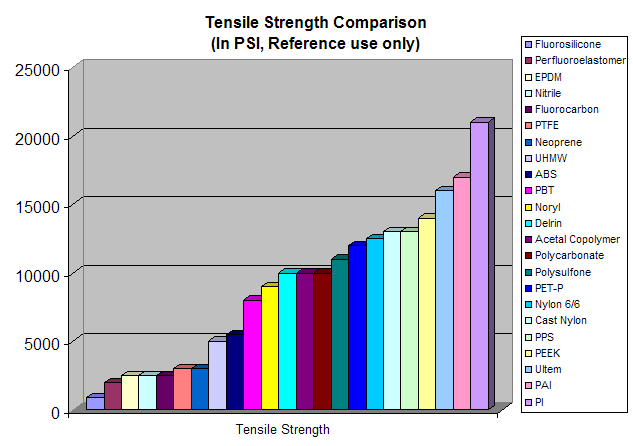
Tensile Strength
bar

This indicates the minimum tensile strength of the elastomer. If the designation has an M after the Revision Year, then this callout is stated in Metric units, megapascals (MPa). If no M is present, then the callout is specifying the English unit, pounds-per-square inch (psi). In this example, the 14 is calling-out 14 MPa. The conversion to psi is: MPa x 145 = psi. Therefore, the psi Tensile Strength requirement of this designation is 14 x 145 = 2030 psi.

Tensile strength is the maximum tensile stress reached in stretching a test piece (either an O-ring or dumbbell).

Tensile tests are used for controlling product quality and for determining the effect of chemical or thermal exposure or an elastomer. In the latter case, it is the retention of these physical properties, rather than the absolute values of the tensile stress, elongation or modulus, that is significant.
agencies

All materials contained in this website is copyrighted. Copyright 2012 O-Rings, Inc. All rights reserved.  ® Each respective company owns respective trade marks.  By visiting our site, you are accepting our terms of use and legal restrictions